

The 2026 Moving to San Diego: The Complete Relocation Guide
Comprehensive Neighborhood Insights & 2026 Market Data. Last Updated: March 2026.
The image above isn’t just a stock photo of our skyline—it’s the view I grew up with looking out from Point Loma. Capturing Shelter Island, the bay, and the San Diego skyline with our mountains as a backdrop represents the incredible diversity that makes up this region.
I’ve watched this skyline and these neighborhoods evolve for decades, and I’ve curated this guide to help you move past the postcards. My goal is to provide the local insight you need to transition from 'visitor' to 'local' with confidence, ensuring you find the specific pocket of San Diego that actually feels like home.
— Rachell Lara
| 2026 Relocation Snapshot | Key Details for Your Move |
|---|---|
| Market Status | Seller-Leaning; Median Detached ~$1.08M / Attached ~$660K. |
| Lifestyle Highlights | From coastal walkability to top-tier family suburbs like Poway. |
| Top Job Hubs | Sorrento Valley (Tech), UTC (Biotech), Coronado (Defense). |
Section One: San Diego Logistics
Work or Lifestyle? Why People Move to San Diego
People move to San Diego for two big reasons: work and lifestyle. Some are transferred here by the Navy, Border Patrol, universities, hospitals, or tech and biotech employers; others choose San Diego first for the laid‑back Southern California feel and then figure out how to make their career fit around that.
San Diego isn’t usually the place you move to chase movie‑star dreams—that’s more Los Angeles territory. It’s the place you move to when you decide you want great weather, a slower‑feeling big city, and the sense that you actually know your neighborhood barista, your kids’ teachers, and your neighbors. In a lot of ways, it’s one of the biggest “small towns” you’ll ever live in.
What makes this area hard to pin down is that San Diego isn’t one single vibe. Within the same county, you’ll find laid‑back surf towns, suburban cul‑de‑sacs with great schools (like the "City in the Country" feel of Poway), rural backcountry, and urban nightlife.
Where San Diego Is & How It’s Laid Out
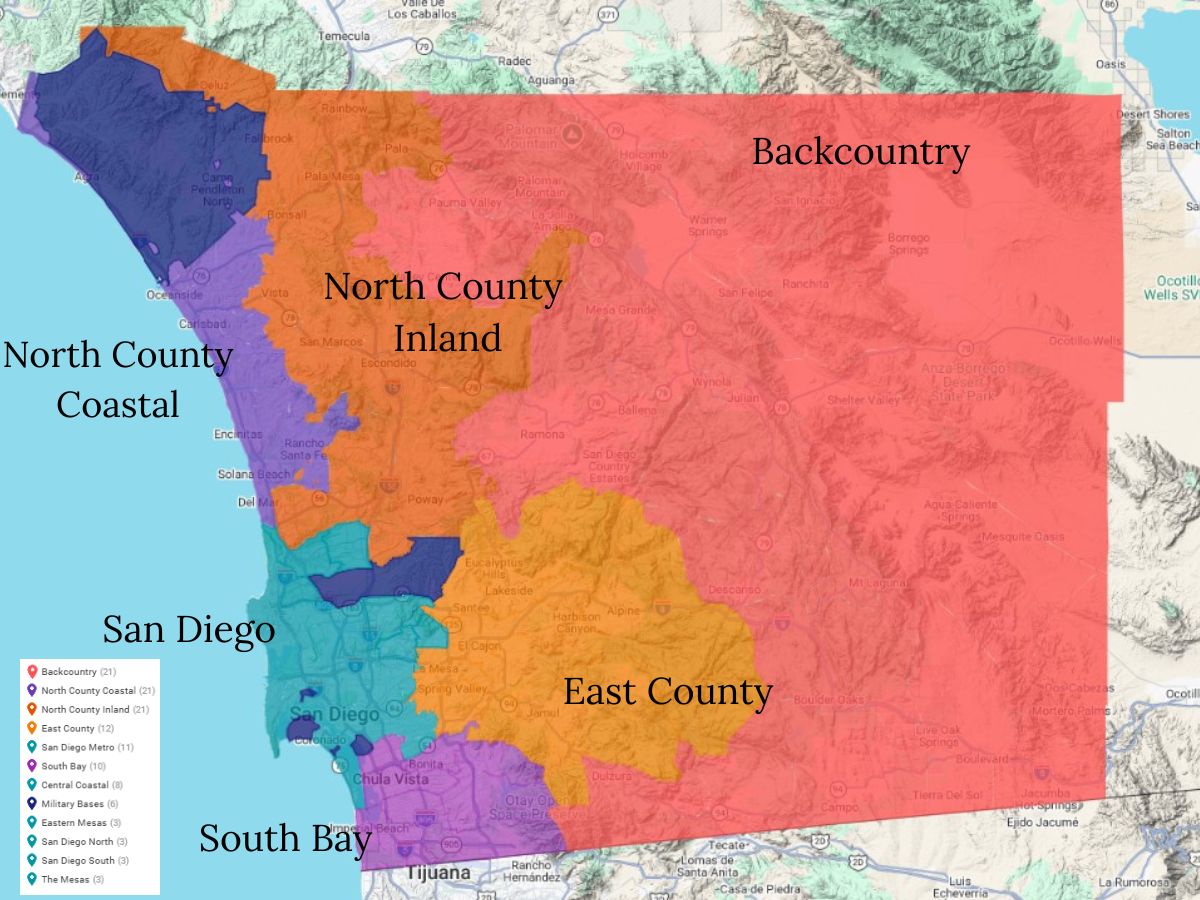
San Diego County is roughly the size of Connecticut. Because of our rugged canyons and coastal ridges, locals navigate using two layers: Major Corridors (the freeways that define your commute) and Specific Regions (the lifestyle zones listed below).
The City & Regional Lifestyle Zones
San Diego County is roughly the size of Connecticut. Because of our rugged canyons and coastal ridges, locals navigate using two layers: Major Corridors (the freeways that define your commute) and Specific Regions (the lifestyle zones listed below).
The City & Metro Lifestyle Zones
Corridors: I-5, I-805, SR-52
The innovation hub. High-density tech jobs meet top-tier family suburbs. Ideal for those working in UTC or Sorrento Valley who want a 15-minute commute.
Corridors: I-805, I-15, SR-52/163
The ultimate central hub. Canyon-front homes with the best freeway access in the county. Split into Central Mesas and Eastern Mesas (Tierrasanta).
The Regional County Guides
Corridors: I-5, SR-78
The suburban gold standard. Balanced between the world-class surf vibes of Carlsbad and the coastal energy of Oceanside.
Corridors: I-15, SR-78/56
Established family hubs and master-planned growth. Features the "City in the Country" feel of Poway and the wineries of Escondido.
Corridors: I-8, SR-52/125/67
Space, foothills, and value. Featuring the historic La Mesa Village and the rural ranch gateways of Alpine and Jamul.
Corridors: I-5, I-805, SR-125/54
Coastal access and planned value. Home to the large-scale communities of Chula Vista and the eclectic beach vibe of Imperial Beach.
Corridors: I-8 East, SR-94/78
Open skies and rugged beauty. Rural retreats in Julian and world-class stargazing and hiking in Borrego Springs.
Climate & Weather: San Diego’s Four Zones
Isn't It Always 70 and Sunny in San Diego?
San Diego is famous for its year-round 70-degree weather, but it’s a little more complicated than that—which is why we might be every meteorologist’s worst nightmare. What most people don’t realize is that we are actually in a desert. It’s a "hospitable desert" only because of our proximity to the Pacific Ocean and the technology that brings water to the region.
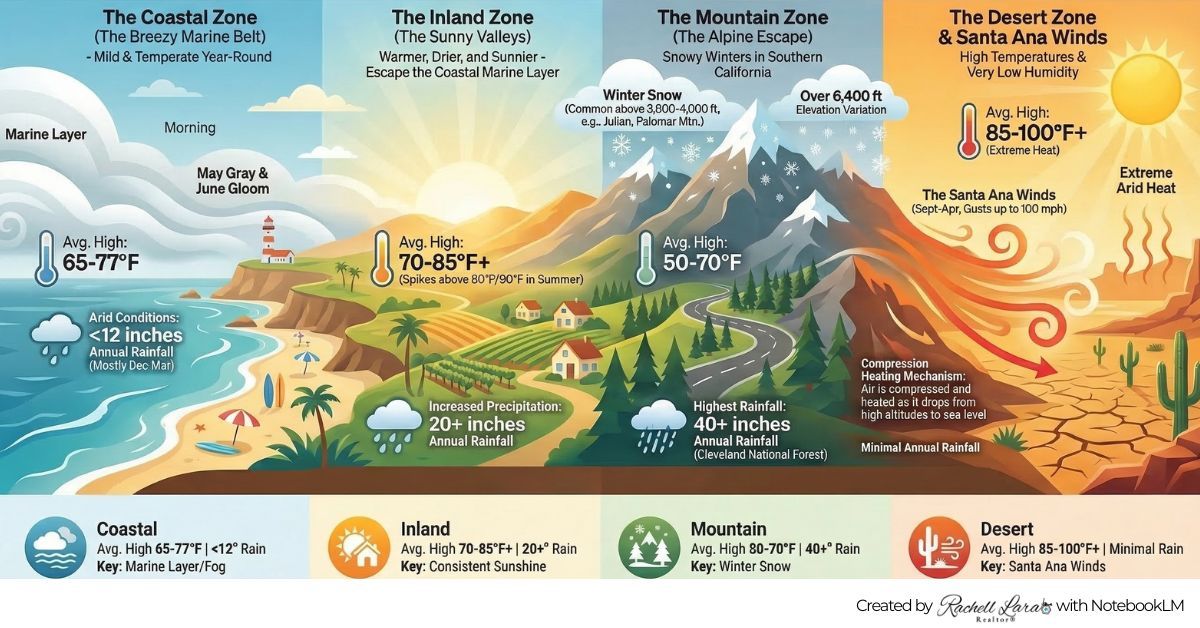
Our 4 Weather Zones & Microclimates
On top of our 4 Major Weather Zones (Coastal vs. Inland vs. Mountains vs. Desert), we have countless microclimates created by our dramatic topography. This is why weather patterns often get "caught" or settle differently.
"I live on top of a hill, so I might wake up to a perfectly sunny morning, while the people at the bottom of the hill are still under a thick layer of fog that settled into the valley overnight."
These microclimates are so distinct that San Diego is able to grow over 200 different types of crops—many of which can’t be grown anywhere else in the continental United States. Between the Marine Layer acting as our natural AC and the dry heat of the Santa Anas, you learn quickly that your wardrobe depends entirely on which specific canyon or ridge you call home.
Cost of Living: Navigating the "Sunshine Tax"
San Diego consistently ranks as a higher-cost market compared to both the U.S. and California averages. For relocation buyers, understanding these numbers up front is the key to choosing a community that matches your lifestyle.
How Expensive is San Diego? Overall, the cost of living here is roughly 50%–55% above the U.S. average. As of March 2026, median home prices in the county sit in the $960,000 to $1.1M range. Rents follow a similar trajectory, with average two-bedroom apartments often hitting $2,800–$3,100.
Everyday Expenses: Utilities, Gas, & Food
● Utilities: SDG&E rates remain among the highest in the state. Inland valleys can easily push a monthly utility bill toward $350+ during summer months. It’s why so many homes here prioritize solar.
● Transportation: Gas prices in San Diego are often $1.00 to $1.50 higher than the national average—currently sitting around $5.50 per gallon.
Housing Budget: Where to Start Your Search
| Budget Range | The Reality: What You Get |
|---|---|
| Under $500k See $500k Homes |
SFRs are rare; primarily 1-2 bedroom condos. Finding inventory West of the I-5 is difficult outside of Downtown or South Bay. |
| $500k – $800k See $800k SF Homes |
Premium Condos/Townhomes in Mission Valley; Entry-level Single-family homes in South Bay or East County. |
| $800k – $1.2M See $1.2M Homes |
Established family hubs in North County Inland (Escondido, San Marcos) and smaller "entry-level" homes in Poway. |
| $1.2M – $2.5M See 3,000+sqft Homes |
Modern master-planned suburban pockets: 4S Ranch, Scripps Ranch, or coastal detached homes in Oceanside and Carlsbad. |
| $3M+ See Ocean View Homes |
Prime Coastal real estate in La Jolla and Del Mar, or sprawling luxury estates in Rancho Santa Fe. |
*Data based on March 2026 market trends. Prices vary significantly by specific neighborhood and home condition.
Schools: What Relocating Families Should Know
Unlike other regions where one district might serve an entire city, San Diego County has dozens of separate districts. Before falling in love with a kitchen, it’s vital to verify your assigned district.
High-performing districts like Poway Unified and San Dieguito often drive the property values in their respective neighborhoods. If schools are your primary driver, we usually start the search by filtering for these specific boundaries.
Local Tip: Always confirm an address using the San Diego County School Finder before making an offer.
District Cheat Sheet
- Poway Unified: STEM & North County Inland favorite.
- San Dieguito: High-performing coastal hub.
- San Marcos: Modern schools & rapid growth.
- Carlsbad: Balanced beach & academic lifestyle.
The Job Market: Innovation & The Military Backbone
The Military Hub
Contributing over $63 Billion to our local economy annually.
- Pt Loma: Submarines & NAVWAR.
- 32nd St: Primary Pacific homeport.
- Miramar: Marine Corps Aviation hub.
San Diego’s economy is diverse and resilient. While the military is the backbone, we are a global leader in Biotech and Life Sciences, primarily clustered in the Sorrento Valley and Torrey Pines "Golden Triangle."
Key Private Sectors:
- Life Sciences: Illumina, Pfizer, and hundreds of startups.
- Defense Contracting: General Atomics and Northrop Grumman.
- Tech: Qualcomm’s massive footprint in Sorrento Valley.
- Healthcare: Anchor systems like Scripps, Sharp, and UCSD.
Transportation: The Art of the San Diego Commute
In San Diego, we don't measure distance in miles; we measure it in minutes. Because our topography is filled with canyons and ridges, two points that look close on a map might require a winding 20-minute drive.
The "Surface Street Trap"
One of the biggest surprises for relocators is that the freeway often isn't the problem—it's getting to the freeway. In neighborhoods like Mira Mesa or Otay Ranch, the high density of homes means that "the 15-minute drive to the 15" is a real factor during morning rush hour.
"When I lived in Mira Mesa, leaving at 6:45 AM meant a 10-minute commute. Leaving at 7:15 AM meant a 35-minute commute. In San Diego, timing is everything."
Freeway Cheat Sheet
The "Big Three" North/South Arteries:
- The 5: Coastal access. Scenic but heavy summer traffic.
- The 15: The Inland backbone. Features the "FastTrak" Express lanes.
- The 805: The local "bypass." Essential for UTC and Sorrento Valley workers.
- The 8: The primary East/West connection.
Pro Tip for Buyers: If you are moving for a specific job, I always recommend doing a "Dry Run" of the commute at 7:30 AM on a Tuesday or Wednesday. This gives you the most realistic picture of what your daily life will actually look like.
Lifestyle & Culture: The San Diego State of Mind
There is a reason people pay the "Sunshine Tax." Life here is built around the outdoors and a legendary craft food and drink scene. Whether you are catching a sunset at Sunset Cliffs or hiking Torrey Pines, the culture is laid-back but high-energy.
Our Cross-Border Culinary Soul
San Diego’s food identity is inseparable from our neighbors to the South. We owe some of the world's most iconic dishes to the Cali-Baja exchange.
- The Caesar Salad: Created at Caesar’s Restaurant in Tijuana in the 1920s.
- The Fish Taco: Born in the street stalls of Ensenada before becoming an SD staple.
- The California Burrito: A local evolution involving carne asada, cheese, and french fries.
The Capital of Craft
While other cities try to claim the throne, San Diego remains the heart of the craft brewing world with over 150 independent breweries. Even if you aren't a beer drinker, the "tasting room culture" is a huge part of the social fabric here. You’ll find world-class pours at the original Karl Strauss and staples like Stone, but the real local magic happens at smaller spots like North Park Beer Co. or the many tasting rooms in Vista.
The "Must-See" Icons
● Balboa Park: 1,200 acres of culture, 17 museums, and the world-famous Zoo.
● The Waterfront: The USS Midway and the Embarcadero—the city's "front porch."
● Old Town: The birthplace of California and our Spanish-Mexican heritage.
● The Beaches: PB for energy, Coronado for families, and the rugged beauty of La Jolla Cove.
The Gameday Ritual
While the "Big Four" professional landscape has shifted, the energy at Petco Park and the new Snapdragon Stadium (home to Wave FC, San Diego FC, and the SDSU Aztecs) remains a cornerstone of the local weekend ritual.
Section Two: Choosing The Area
With over 100 named neighborhoods and dozens of unique cities, narrowing down your search can feel like a full-time job. To find your "perfect" home, look past the photos and answer these three fundamental questions.
1. How Do You Want To Live Day-To-Day?
Are you looking for a Coastal lifestyle where you can walk to the surf? An Urban vibe near Little Italy? Or a Suburban hub with top-tier schools and quiet cul-de-sacs?
Identifying your "lifestyle non-negotiables" early will save you weeks of looking at the wrong homes. If you need a half-acre and a three-car garage, your search will naturally drift toward North County Inland or East County.
2. What’s Your Realistic Budget?
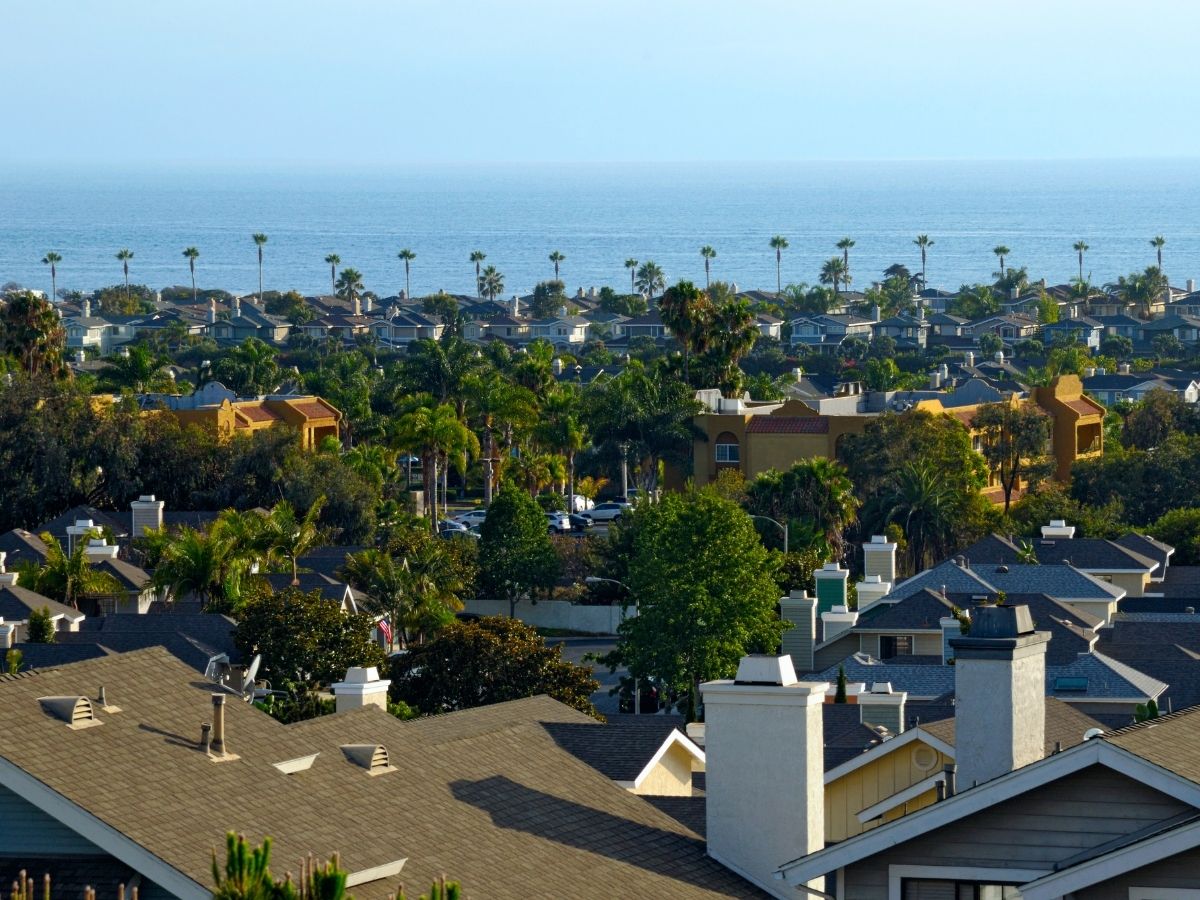
The difference between $900k and $1.5M in San Diego isn't just about the house—it’s about the location. Don't forget hidden costs like Mello-Roos (common in North County and South Bay) and HOA fees.
Look at your "Total Monthly Payment" rather than just purchase price. Extra assessments or higher insurance in canyon or rural areas can change your buying power by $100k or more.
3. How Long Are You Willing to Commute?
● The Surface Street Trap: It’s often not the freeway that gets you—it's the neighborhood. In Mira Mesa, a drive to the I-15 can take 6 minutes at 5 AM, but 30 minutes during the rush.
● The Hybrid Advantage: If you have a hybrid schedule, a longer commute from a place like Temecula or Alpine becomes a strategic choice for a larger yard.

Ready to Explore Specific Neighborhoods?
Not sure where to start? Visit our Explore San Diego hub for regional summaries and community lists. If you've already narrowed your search or are ready for a deeper dive, jump directly into a Regional Guide below.
Section Three: Choosing Your San Diego
Defining the lifestyle, neighborhoods, and community dynamics that align with your long-term goals.
Is San Diego a Good Place to Live?
The short answer? Yes. But the real reason people stay is the diversity of lifestyle. No matter what environment you're looking for, San Diego has a world-class version of it to offer. While the rest of the world sees us as a postcard of beaches and sunshine, those who live here know it is a massive, thriving county with deep roots and unmatched opportunity.
The "Good" (Beyond the Postcard)
- Microclimate Choice: You aren't stuck with one "type" of weather. You can choose the coastal marine layer, the dry heat of the foothills, or even the four seasons of the mountains.
- Economic Resilience & Agriculture: We aren't a one-industry town. Beyond the military, biotech, and healthcare, Agriculture is a top-five economic contributor. San Diego is home to more small, family-owned farms than any other county in the U.S.
- The Lifestyle Spectrum: You can enjoy an urban, high-rise life on Friday and be on a 10-acre horse ranch or a mountain cabin on Saturday—all without ever crossing the county line.
The "Outdoor Room" Advantage
Because San Diego homes often run smaller than what you’ll find in other states, we treat our yards as primary living space. In San Diego, you aren't just buying square footage—you're buying an extension of your home that never goes out of season. Our "living rooms" have no ceilings.
The Reality Check: The Friction Points
The "Sunshine Tax" is real. San Diego consistently has some of the highest utility and fuel costs in the nation. To thrive here, most buyers find their balance using the "Choose Two of Three" rule:
Unless you are in the upper echelon of the market, you will likely compromise on one of these three pillars. Understanding this trade-off early is what makes the lifestyle sustainable.
If San Diego sounds like a good fit for you, the next step is figuring out which version of the county fits your life today.
Planning Your Move: Choosing Your Version of San Diego
The secret to a successful relocation is realizing that you aren't just moving to a city; you are selecting an environment. The first step is identifying which "flavor" of San Diego matches your life today.
The Lifestyle Menu
- The Coastal Spectrum: From the unpretentious surf vibe of beach bungalows in Ocean Beach, to the active energy of North County Coastal, and the historic luxury of La Jolla and Coronado.
- Suburbs & Golf Communities: Master-planned convenience in areas like Carmel Valley or Rolling Hills Ranch and the prestigious fairways of Rancho Santa Fe.
- Ranch, Vineyard & Mountain: Private vineyards in the foothills of Fallbrook and Escondido, or functional ranches and mountain cabins in Julian.
- The Urban Pulse: Walkable luxury centered around the dining mecca of Little Italy and Downtown.
The Pressure Release
One of the biggest hurdles in relocating is the fear of choosing the "wrong" spot. In San Diego, that pressure is a myth. Your first home is simply your entry point.
"I’ve lived this evolution myself. I grew up in Point Loma, bought my first home in Mira Mesa, and eventually moved out to the Country when my life required a different pace. I never left San Diego, but I lived three completely different lives."
Find the version of San Diego that fits your life today. As you grow, the city will grow with you.
⚓ The PCS Perspective
If you’re moving here on orders, you’re stepping into a community of over 100,000 active-duty service members. While proximity to 32nd St, Miramar, Point Loma, or North Island usually dictates the initial search, I specialize in looking beyond the base gates to help you find the specific neighborhood and lifestyle you actually want.
Strategic Investment & The Long-Game:
San Diego appreciates more than almost any other market. We help you pick a home that works as a strategic investment so that if you move on but want to return for retirement, your property has built the equity to make that possible.
How I Help Military Families:
- Beyond the Gates: Finding the lifestyle that fits your family, not just your commute.
- VA Loan Mastery: Using your benefit as a high-leverage tool in a high-appreciation market.
- Deployment Support: Serving as your boots on the ground with virtual tours and local vetting.
How to Work With Me
Relocating is a strategy, not just a move. Here is our roadmap to getting you settled:
A 15-minute chat to discuss your timeline, commute tolerances, and must-haves.
I match your goals against San Diego’s micro-markets to find your ideal "entry point."
Whether in-person or virtual, we vet homes for lifestyle fit and long-term resale or rental value.